Muay Thai
Muay Thai Camps in Thailand: How to Choose One, and What No One Checks Beforehand
All skill levels are welcome, including complete beginners. But there’s a screening process before you choose a camp, and almost no one goes through it.
Verified on . This page is updated whenever the rules change.
Training in Thailand is accessible to people of all skill levels, including those who have never put on gloves before. The camps welcome beginners, divide participants into groups, and training costs a fraction of what it does in Europe. Understanding what Muay Thai means in Thailand changes the way you approach your first morning there.
But there’s one thing almost no one checks, and it comes before choosing a camp: Does your insurance cover combat sports? Most travel insurance policies and credit card coverage explicitly exclude them. You usually find this out at the hospital, with a broken tibia and a bill you have to pay yourself.
The rest is a matter of choice, and it boils down to four questions: where, what kind of camp, how long, and what kind of visa.
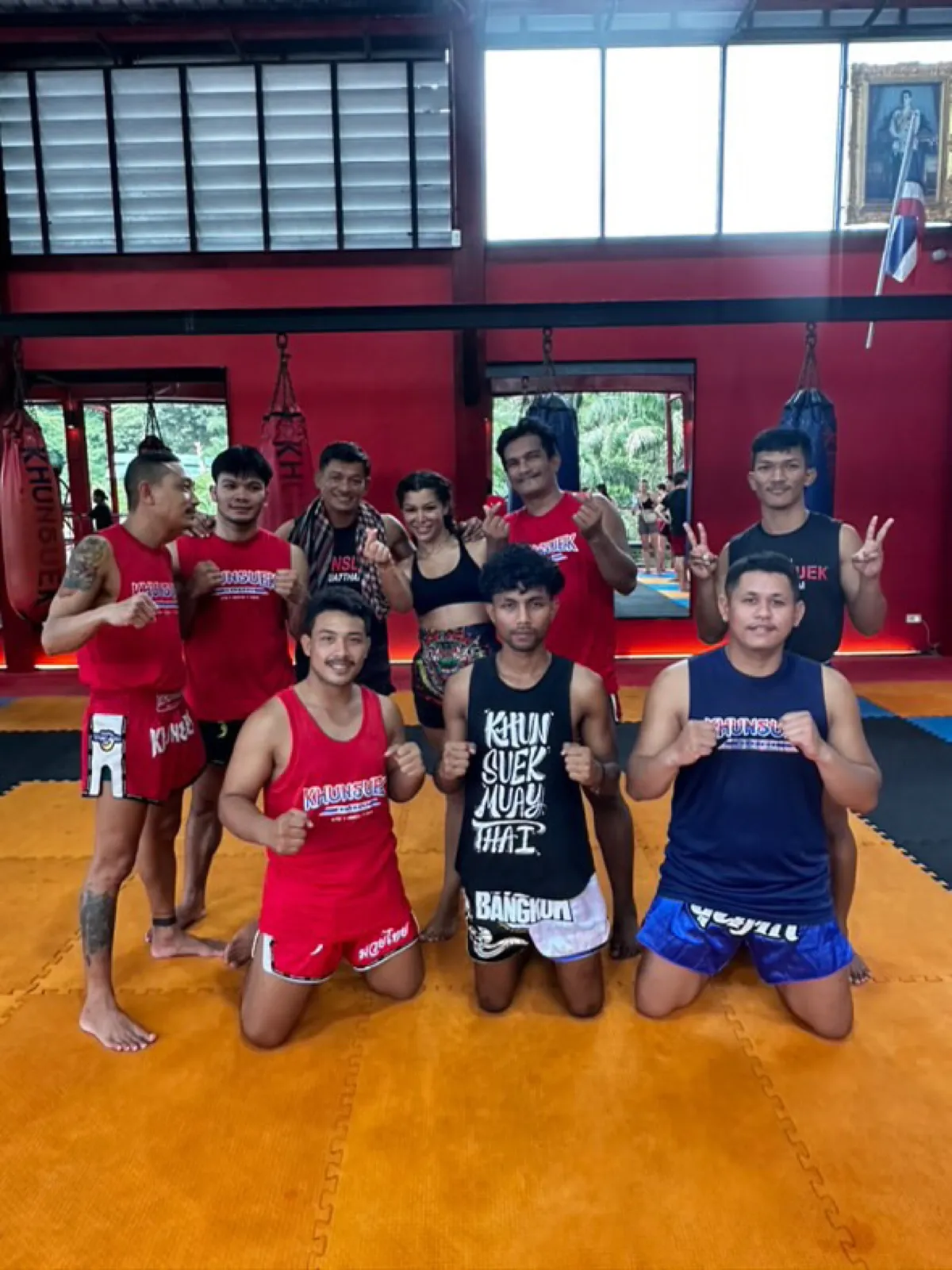 Seen on site
Training camp or summer camp—it's the same thing
Both terms refer to the same thing. A workshop is generally shorter than a camp, but how the terms are used depends mostly on the people involved and the organizations. Don't look for a difference in nature—look for differences in duration, pace, and supervision.
Where to Train, Region by Region
| Where | Who is it for? | The downside |
|---|---|---|
| Phuket | The best-known and best-organized camps for foreigners, all skill levels, English spoken everywhere | the most expensive, and the least exotic |
| Chiang Mai | a much more pleasant climate, an established community, and a low cost of living | Burning from February to April, poor air quality |
| Koh Samui and Koh Phangan | island setting, small camps, the ocean after practice | Unseasonable weather, a very rainy November |
| Isan | the most traditional camps, in the region where most of the champions come from | Rare English, basic amenities, few foreigners |
The climate matters more than we realize when we train twice a day: see “weather” and “climate.” And for the Isan region, thenortheasterly wind explains why the region produces so many fighters.
What is a typical day like?
| Early in the morning | running, jump rope, then about two hours: bag work, bear crawls with a trainer, clinch |
|---|---|
| Midday | Rest—and it's not optional: the heat and humidity make physical exertion impossible |
| Late afternoon | Second session, same format, often with more sparring |
| In the evening | stretching, meals, and going to bed early if you want to keep up the pace |
What to Check Before Booking
First, insurance. A policy that excludes combat sports won’t be of any use when you need it most. You need coverage that explicitly includes them, including training at a club. Details on exclusions can be found on the Thailand travel insurance page.
A visa is required if you're staying for a long time. The visa waiver is sufficient for a short stay. For longer stays, the upcoming DTV visalistsMuay Thai training among its eligibility criteria, making it the most direct route. General information can be found on the Thailand visa page.
The coach-to-student ratio. This is the only quality metric that can be verified remotely, by looking at photos and videos from the camp. One coach for every fifteen people won’t be able to correct anyone.
Accommodations on-site or nearby. Staying at the camp is more expensive but makes everything easier, especially with two sessions a day. Staying nearby is less expensive but involves a commute—usually by scooter—twice a day, which brings up the issue of insurance.
How long
A week is enough time to learn the ropes and make significant progress, but your body has a hard time adjusting at first: your shins and ankles really take a beating.
Two to four weeks is the most productive timeframe: it gives you enough time to get past the adjustment period and really get to work.
After a month, the issue of visas comes up, as does the question of pace: almost no one can handle two sessions a day, six days a week, for three months.
What to Bring
The idea is simple: buy clothing locally for much less, and bring protective gear that comes into contact with the body from France. Details on what to pack in each half of the suitcase can be found on thepage “Buying Gear in Thailand.”
Watch a fight while on vacation
It's the obvious complement to training, and it appeals to a much wider audience. Ticket prices and venues are listed on thepage for watching a Muay Thai fight.
In summary
All skill levels are welcome, including complete beginners, and training costs a fraction of what it does in Europe. Phuket for the organization, Chiang Mai for the climate, the islands for the setting, and Isan for the tradition. Two sessions a day—one in the morning and one in the late afternoon—with a mandatory break in between. Two to four weeks is the duration that yields the best results. And above all else, make sure your insurance explicitly covers combat sports: almost none of them do so by default.
How much does a Muay Thai camp in Thailand cost?
Training alone is often paid for on a per-session or per-week basis, at very low rates compared to Europe. Packages that include on-site accommodations cost more but are still incomparably cheaper than an equivalent training camp in France. Prices vary widely depending on the camp’s reputation and the island.
Do you need to be at a certain skill level to attend a Muay Thai camp in Thailand?
No. The vast majority of camps welcome complete beginners and divide participants into groups by skill level. Coaches adjust the intensity, and it’s common to see people who’ve been practicing for ten years alongside those who are just starting out in the same gym.
Where can you find the best Muay Thai camps in Thailand?
Phuket is home to the best-known and most organized camps for foreigners. Chiang Mai offers a more bearable climate, Koh Samui and Koh Phangan offer an island setting, and Isan has the most traditional camps—in the region where most of the champions come from.
What's a typical day like at a Muay Thai camp?
Two sessions a day—early in the morning and late in the afternoon—to avoid the heat. Each session lasts about two hours and includes running, rope work, bag work, bear-claw drills with a trainer, clinching, and stretching. The middle of the day is set aside for rest, which is essential.
What kind of insurance should I get for a Muay Thai camp in Thailand?
A policy that explicitly covers combat sports. Most travel insurance policies and credit card coverage exclude them, even for training at a club. This is the most important step in your preparation—even more important than choosing a training camp.
What kind of visa do I need to train in Thailand for an extended period?
The visa waiver is sufficient for a short stay. For longer stays, the DTV visa—designed for extended stays—explicitly lists Muay Thai training among its eligibility criteria, making it the most direct route for a stay of several months.